

Helping leaders emerge

Blog


The Science of Emotional Regulation

Understanding your nervous system and emotional regulation is becoming increasingly relevant to how we lead, perform, and recover under pressure.

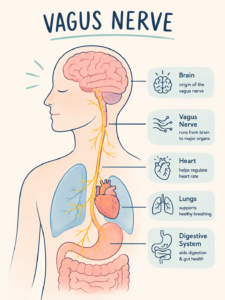
Dr. Kevin J. Tracey, president and CEO of the Feinstein Institutes for Medical Research and a pioneer in vagus nerve research, shares a compelling perspective on the body’s major two-way superhighway: the vagus nerve, a network of 200,000 fibers coordinating critical functions throughout your body and performing specialized jobs to keep you healthy. In his latest book, The Great Nerve: The New Science of the Vagus Nerve and How to Harness Its Healing Reflexes, Tracey explores how this complex system connects your brain to vital organs, helping regulate heart rate, inflammation, and overall balance in the body.

The Big Idea

The vagus nerve plays a central role in how your body maintains stability and responds to stress. While there is a growing wave of “biohacking” advice (trendy wellness hacks) online, Dr. Tracey emphasizes that many claims are overstated or lack solid backing. Much of the popular advice on “optimizing” vagal tone (your body’s capacity to relax and recover) is not yet supported by robust scientific evidence. While tools and techniques can help, they are not magic fixes. The basics still matter most.

The real foundation of a healthy nervous system depends on everyday habits, not gadgets. Simple, consistent practices like breathwork, physical movement, social connection, and quality sleep play a meaningful role in regulating your nervous system and reducing inflammation.

Six Practical Ways to Support Your Vagus Nerve

  • Practice slow, deep breathing. Try a simple practice called “straw breathing”: inhale for three seconds, then exhale slowly for seven seconds through pursed lips—like you’re blowing through a straw or gently blowing out candles on a cake. Just a few minutes each day can help calm your system. One of my clients uses this practice during board meetings to stay grounded and calm.
  • Prioritize regular exercise. Consistent aerobic movement, like walking, cycling, hiking, or jogging, supports overall nervous system health.
  • Get restorative sleep. Aim for seven to eight hours of quality sleep each night. Sleep is emotional first aid, and your nervous system depends on it.
  • Cultivate social connection. Meaningful relationships and community engagement are deeply supportive for your emotional and physiological health.
  • Try safe cold exposure. You don’t need expensive tubs or retreats. Simply ending your shower with two to three minutes of cold water or splashing your face with cold water can gently stimulate your vagus nerve (check with your doctor first).
  • Incorporate mindfulness or meditation. Simple, daily practices that focus on relaxation and breath awareness can promote calm and resilience. Research suggests even eight minutes a day, including short “micro-hits” throughout the day, can make a meaningful impact.

The takeaway is straightforward: emotional regulation and nervous system health are built through simple, consistent habits, not complexity or gadgets.

For more information, click here to listen to the podcast The Science of Regulating Your Nervous System with Dr. Kevin Tracey on 10% with Dan Harris (April 27 2026; one hour 25 minutes).

A Simple Reset for Busy Leaders: The Power of a Pause

Last week I had the opportunity to facilitate a leadership retreat focused on something that many of us don’t prioritize enough—rest, recharging, reconnecting (with ourselves and others), and supporting overall well-being.

Amid busy schedules, constant decision-making, and high expectations, we took time to explore a few simple practices that can help create space, restore focus, and reset in real time.

I thought I’d share a short Breathing and Tapping Practice Guide from the session—practical tools you can use throughout your day, whether you’re preparing for a meeting, navigating a stressful moment, or simply looking to pause and reset.

__

 Breathing + Tapping Guide: Simple, accessible practices­­—no special setup needed.

  1. Physiological Sigh

A fast reset when experiencing a sudden stress or anxiety spike

  • Inhale (deep)
  • Inhale (quick top-up)
  • Long sigh out
  • Repeat: 2–5 times
  1. 4–6–8 Breathing

To cultivate deeper calm when feeling anxious, wired, or unable to relax (especially helpful before sleep)

  • Take a few normal breaths
  • Inhale 4
  • Hold 6
  • Exhale 8
  • Repeat: 4–8 rounds
  1. Straw Breathing

A gentle way to regulate when feeling overwhelmed, or a subtle reset in public settings (e.g. before meetings, during meetings, or useful when stuck in traffic!)

  • Take a few normal breaths
  • Inhale through nose
  • Exhale slowly through pursed lips (as if through a straw or blowing out a candle)
  • Repeat: 1–3 minutes
  1. Box Breathing (4–4–4–4)

To support clarity, focus, and composure—particularly useful before important conversations or presentations.

  • Take a few normal breaths
  • Inhale 4
  • Hold 4
  • Exhale 4
  • Hold 4
  • Repeat: 4–6 cycles
  1. Tapping

To reduce emotional intensity and interrupt stress patterns

  • Use 2–3 fingers and tap gently
  • About 5–10 taps per point
  • Points are throughout your body and wherever you feel tightness such as eyebrow, side of eye, under eye, under nose, chin, collarbone, under arm, and top of head.
  • As you tap, simply notice what you’re feeling—no need to judge or change it
  • Continue tapping and allow the body to settle
  • Practice: for 1–3 minutes, (or longer if helpful)

Closing Note

A slightly longer inhale can help energize and refocus the mind and body, while a longer exhale calms the system and activates the body’s “rest and digest” response.

These practices are intentionally simple—but when used consistently, they can be powerful tools for staying grounded, present, and effective throughout the day.

If any of these practices resonate, I encourage you to try one or two throughout your day—especially in moments where a pause could make a difference.


Emotional Intelligence: Why A Lower Score Might Be a Good Thing

I’m always curious how clients describe and rate their own emotional intelligence — and how they assess others. Interestingly, those who rate themselves lowest often demonstrate the highest emotional intelligence. And the reverse is true, too.

Why? Because self-awareness is the foundation of it all.

Those with higher emotional intelligence tend to have a more honest, often more humble, view of themselves. They notice their blind spots, mistakes, and emotional patterns. In contrast, those who overestimate their EI are often missing that very self-awareness.

This month, I want to break down emotional intelligence (EI) using Daniel Goleman’s simple four-part framework. I often share this model with clients because it’s easy to remember and deeply practical.

It also aligns with the definition of mindfulness: being aware of what’s happening in both our internal and external environments—and then choosing how to respond in a thoughtful, intentional way. The opposite is being unaware of what’s happening internally and externally, and reacting out of habit.

Emotional Intelligence is also one of the strongest predictors of success in both work and life. And the good news? It’s not fixed; it’s a skill we can develop.

Daniel Goleman defines emotional intelligence (EI) as the capacity to recognize our own feelings and those of others, to motivate ourselves, and to manage emotions effectively in ourselves and in our relationships.

Goleman’s Emotional Intelligence Four-Part Framework

1.    Self-Awareness: What we know about ourselves.

Self-awareness is the practice of self-reflection and the starting point of personal growth. Journaling, meditating, or speaking with a friend, coach, or therapist are helpful ways to cultivate it.

  • What am I feeling?
  • How am I showing up?
  • Am I being triggered?
  • What feedback am I seeking from people I trust?

2.    Self-Management: What we do based on what we know.

Self-management is the ability to pause, regulate, and choose your response rather than react automatically. I often call it the power of the pause — interrupting thoughts and emotions long enough to respond intentionally. This is where maturity lives.

Self-management isn’t about suppressing emotions but rather working with them skillfully. Emotions will arise — they always do. The real question is: what helps you pause and respond wisely?

A Viktor Frankl quote captures what it means to have a self-management practice: “Between the stimulus and response, there is a space. And in that space lies our freedom and power to choose our response.”

Practices that clients say strengthen self-management include:

  • Deep belly breathing
  • Meditation (breath, body, loving-kindness)
  • Prayer or spiritual reflection
  • Prioritizing sleep (emotional first aid)
  • Reducing caffeine
  • Connecting with supportive people
  • Hanging out with your favorite dog or cat
  • Movement and exercise
  • Time outdoors and in nature
  • Journaling
  • Baking and cooking
  • Listening to music
  • Laughter

What works for you?

Strong self-management creates the foundation for how we show up for ourselves and others.

3.    Social Awareness: What we know about others and our environment.

Social awareness is the practice of deep, empathetic listening, both for what is said and for what isn’t said. It’s also about tuning in to the environment around you.

  • Am I listening more than I’m talking?
  • What might the other person be feeling?
  • What am I noticing in their tone, body language, and energy?
  • What’s going on in the environment around me—the workplace, the room, the broader context?

4.    Relationship Management: What we do based on what we know.

Relationship management is the integration of self-awareness, self-management, and social awareness, and taking action on what we know in order to be of service to others.

This includes influencing others, navigating crucial conversations, managing conflict, coaching and mentoring, and providing inspirational leadership. At its core, it reflects the ability to apply emotional awareness of both self and others to build and sustain strong, productive relationships.

As you reflect this month, you might consider:

  • How much time do I allow for self-reflection?
  • How often do I check in with myself and others before responding, or do I fall into a habitual, reactive mode?
  • What might I commit to trying in order to manage myself more effectively?
  • What are some ways I can cultivate stronger relationships at work and at home?
  • Where do I naturally excel within this framework? What areas might I want to further develop?


What’s Really Driving You?


This month I’m sharing insights from Why Buddhism Is True by Robert Wright, a book that has deepened my understanding of how our brains work and what enables us to lead with self-awareness, sound judgment, and a confident presence — at home, in our communities, and at work.

Wright argues, drawing on Buddhist teachings as well as modern neuroscience and evolutionary research, that our brains evolved for survival and status, not clarity. As a result, we’re wired for bias and self-protection, tendencies that can quietly distort perception and judgment and contribute to a persistent sense of dissatisfaction.

This means the mind you lead with comes preloaded with reactive “factory settings.” Leadership effectiveness depends on recognizing those settings and learning to work with them skillfully rather than being ruled by them.

Before diving into the leadership implications, it helps to understand one of Wright’s core ideas: the mind is not a single, unified decision-maker. Instead, it is made up of different brain “modules,” each shaped by evolution and designed to solve a survival problem. These brain modules are constantly competing with one another for influence. At a basic level, they revolve around threat detection, status protection, mate attraction, and social bonding. They evolved to help our ancestors survive and reproduce — not necessarily to help us think clearly or lead wisely.

Each evolved brain module has its own goal. It influences us by generating feelings tied to that goal: anxiety when threat is detected, pride or defensiveness when status feels at stake, desire when attraction is activated, and warmth or attachment when social bonds are strengthened or strained, creating a strong urge to act, even when that action may not serve the situation. Much of this happens quickly and outside our conscious awareness. In any given moment, the brain module that is strongest can shape how we interpret events and respond.

Because these feelings and reactions seem true and urgent in the moment, we mistake them for reality. This helps explain how any of us, even at our best, can become reactive, defensive, or overly certain, and why awareness of what is driving us is essential to sound judgment.

Ten Leadership Lessons Inspired by Why Buddhism Is True by Robert Wright

1. Your mind wasn’t built for truth – it was built to keep you safe.

When a situation feels personal or high-stakes, the self-protection, status-seeking, or threat-detection brain modules may shape your first interpretation. Strong leaders don’t assume they’re unbiased; they assume they’re human. Pausing to ask, “Which part of me is reacting?” creates space for clearer judgment and sounder decisions.

2. The status-seeking module in the brain is never fully satisfied.

The part of the mind (brain module) wired for achievement and recognition rarely stays satisfied for long. After a promotion, a win, or praise, the relief fades and the drive returns. When leaders recognize this pattern in themselves, they are less likely to build cultures of chronic striving and more likely to foster sustainable motivation.

3. Intensity doesn’t always signal importance. 

Strong reactions can feel like a sign that something deeply important is at stake. But emotional intensity often reflects activation of a brain module, not necessarily a violation of core values. Leadership maturity involves pausing long enough to ask whether the reaction reflects self-protection, or what best serves the situation.

4. While defensiveness is natural, non-defensiveness is a core leadership skill.

The mind instinctively works to preserve a positive self-image. When feedback threatens that image, defensiveness is a natural reaction. Leadership growth begins when we can notice that reflex and remain open rather than protective. Learning to receive feedback without becoming defensive and to separate identity from a single moment of critique is one of the most important leadership skills we can develop.

5. The threat-detection brain module is always scanning.

We are wired to notice problems faster than what’s working. In leadership, that can create overcorrection, hyper-vigilance, or defensiveness. Awareness of this bias helps leaders respond proportionately rather than reactively, preserving perspective and optimism even while addressing real challenges.

6. The mind defends intention; leadership requires owning impact.

When something goes wrong, our first instinct is often to explain what we meant: “That’s not what I intended.” The blame-avoidance or status-protection brain module steps in quickly.

Leadership maturity means shifting the focus from intention to impact by asking, “How did this land?” and “What effect did it have?” — even when the answer is hard to hear. Strong leaders take responsibility for impact, not just intent.

7. Emotions are signals of activated brain modules.

Each module in the brain has a goal, but that goal is rooted in instinct and survival. It is not necessarily aligned with what best serves us as human beings or as modern leaders. To move us toward behaviors that increased survival or status in the past, each module generates powerful feelings to motivate action. Anger may arise from the fairness-tracking module, pushing us to correct a perceived wrong. Anxiety may come from the threat-detection module, urging self-protection. Pride may reflect status-seeking, encouraging us to assert competence. Desire may reflect pleasure-seeking, pulling us toward reward.

These feelings aren’t random. They are motivational tools designed to trigger action quickly. But what once served survival doesn’t always serve sound judgment. Leaders who notice the feeling before acting on it create space for wiser, more intentional decisions.

8. Conflict often reflects threatened instincts, not just different opinions.

When conflict arises, it rarely feels calm or neutral. It feels charged. That’s because something important feels threatened: status, fairness, belonging, or safety. When one of these brain modules is activated, it generates strong emotion and pushes us to defend our position.

This is why conflict can feel so personal and intense. It’s not just about the issue at hand; it’s about protecting something that feels important. Recognizing this helps leaders slow down and ask, “What feels threatened here?” That question can reduce escalation and shift the focus from winning to understanding.

9. Mindfulness creates space between impulse and action.

Reflection-based practices like the RAIN meditation (see Additional Resources below) don’t silence the brain’s modules; they help us notice which one is strongest in the moment. Instead of automatically acting on the loudest feeling, whether it’s anger, anxiety, pride, or urgency, leaders learn to pause and observe.

That pause doesn’t erase the emotion, but it often softens its intensity. By reducing the intensity of the immediate reaction, leaders experience a greater sense of space between a feeling and a behavior. Rather than reacting from a single dominant module in the brain, leaders can choose to pause, carefully examine their thoughts and emotions, and respond in a way that is more aligned with the needs of the situation.

10. Compassion becomes practical.

If we recognize that everyone in the room shares the same evolved human wiring, made up of brain modules designed for self-protection, status, fairness, and belonging, then reactive or defensive behavior makes more sense. It doesn’t excuse poor behavior, but it does make it more understandable.

Seen this way, compassion isn’t soft; it’s pragmatic. When leaders recognize the underlying human wiring at play, they respond with steadiness rather than judgment. Working with those instincts, rather than fighting or shaming them, creates more influence, trust, and forward movement.

Ultimately, if our brains come with built-in survival wiring, leadership growth begins with learning to see that clearly. The ability to pause and self-check before responding, especially when emotions are strong, is one of the most important leadership skills we can develop. That brief pause allows us to notice which brain module is driving us and choose a response rather than default to a reaction. The more aware we become of the internal dynamics shaping our reactions, the more choice we cultivate in how we lead, and the less personally we take what happens within and around us.

Additional Resources

  • Click here for the meditation: RAIN by Jeff Warren — Recognize, Accept, Investigate, and Non-identification — a practical, step-by-step method for noticing reactive “factory settings” and working skillfully with the brain modules and emotional signals described in Why Buddhism Is True.
  • Click here to listen to Why Buddhism is True with Robert Wright on 10% Happier with Dan Harris (episode 95; 63 minutes).


What I Learned from Mountains and Oranges

I hope this finds note you well, and I’d like to start off the year by wishing you a healthy, joyful, and meaningful 2026.

Recently, I found myself feeling somewhat unsettled by the state of the world, along with a few personal challenges that – while not long-term issues – were still difficult to navigate. I felt particularly vulnerable and in need of a practice to cultivate resilience and inner strength. During that time, I was reminded of a practice that my meditation community and I have returned to over the years whenever we’ve needed to feel more grounded.

With that in mind, this month I’d like to share the Mountain Meditation, a twenty-minute guided practice by Jon Kabat-Zinn, to support what many of the leaders I work with describe as executive presence – a sense of confidence, calm, and focus – particularly during difficult and uncertain times.

Here’s How the Mountain Meditation Can Help

  • Offers guidance for a properly aligned seated posture, whether in a chair (for most humans!) or on the floor
  • Cultivates a feeling of being centered, rooted, and calm during periods of challenge, change, and uncertainty
  • Uses the image of the most beautiful mountain you have seen– or can imagine – to evoke a feeling of strength and stability in the body
  • Highlights that thoughts, emotions, and inner storms, though they feel personal and permanent, are impersonal in nature and will pass when met with awareness and kind attention

This Month’s Favorite Resources

The Mountain Meditation by Jon Kabat-Zinn: Click here for the guided meditation on Sound Cloud (you will be asked to sign in and sent a passcode) or click here for the meditation on YouTube (both are 20 minutes) OR click here for the guided mountain meditation script

The Drive Podcast: Click here to listen to The Impact of Gratitude, Serving Others, Embracing Mortality, and Living Intentionally with Walter Green and Peter Attia. Walter Green is a remarkable philanthropist, mentor, author of This Is the Moment!, and founder of the impactful “Say It Now” movement. (1.5 hours)

The Wall Street Journal (for subscribers): Click here to read What Readers Want to See in the Workplaces of the Future. (Jan 5, 2026)

The New York Times (for subscribers): Click here to read or listen to This Question Can Change Your Life on The Ezra Klein Show with Stephen Batchelor, author of many books on Buddhism and meditation. (Jan 2, 2026)

A Poem by Wendy Cope – The Orange

At lunchtime I bought a huge orange–

The size of it made us all laugh.

I peeled it and shared it with Robert and Dave–

And that orange, it made me so happy.

As ordinary things often do

Just lately. The shopping. A walk in the park.

This is peace and contentment. It’s new.

The rest of the day was quite easy.

I did all the jobs on my list

And enjoyed them and have some time over.

I love you. I’m glad I exist.

Winter

Remember that even though it’s the end of the year, it’s also winter.

Which means that in nature, everything slows down.

Unlike hustle culture that tells you to speed up, and push through the holiday stress – winter reminds us that the closing of the year is actually time to go within, to slow down, and to rest.

So if you’re feeling an urge to hibernate, a yearn to do less, a longing for slowness, know that your body is reminding you of the rhythm of the current season – and that’s a beautiful thing.

If nature is designed to slow down during this time, so are we.

@lexyflorentina