

Blog
How to Show Up and Lead with Intention for 2019!
Practice sharing the fullness of your being,
your best self, your enthusiasm, your vitality,
your spirit, your trust, your openness, above all your presence.
Share it with yourself, with your family, with the world.
– Jon Kabat-Zinn
Given the fast pace of life, constant distractions, and multitude of demands placed upon us, we often struggle with showing up at our best – especially during important work and personal situations. Whether it’s a meeting, dealing with a toxic co-worker, setting limits with a challenging teenager, or being compassionate toward an aging family member, it’s helpful to pause and remind ourselves – what’s my best intention for this situation?
In coaching, executives quickly learn that that how they say something – that is their style and how they show up – is just as important as the content of what they are saying. An executive recently shared, “I now spend a lot more time thinking and preparing for interactions with others, above and beyond the content itself. Working on grounding myself as well as preparing for difficult meetings has been very helpful. Not surprisingly, this has been helpful in my personal life as well.”
But how do we show up at our best – especially when there is the potential to become triggered? Here is an effective, simple exercise for showing up as your best self that works great at work or in your personal life!
How to Show Up and Lead with Intention!
Step One: What is my goal? What do I want? What is my preferred outcome for the conversation? What does success look like from the other person’s point of view?
Client examples include (recommend identifying 1-3 goals):
• Learn more about the job and explore if the fit is right
• Get the job offer
• Get the promotion
• Make a good impression
• Make sure my body language and tone communicate interest in the other person
• Communicate important information
• Influence an important decision
• Share my point of view
• Delegate an important task to my direct report
• Provide the tough feedback
• Offer support in a difficult situation
• Offer career support and advice
• Gather information
• Actively listen and build trust
• Be present with the person and refrain from offering advice
• Pause before I respond
• Connect and strengthen the relationship
• Demonstrate I care about the other person
• Establish better boundaries
• Have fun
Step Two (my favorite step!): What is my best intention for how I want to Show Up? What would I want the other people(s), or a fly on the wall, to say about how I was “being”?
Client examples include (recommend identifying 3-5 attributes):
• Present
• Engaged
• Grounded
• Confident
• Approachable
• Authentic
• Empathetic, active listener
• Able to understand and respect others’ point of view
• Nonjudgmental
• Curious
• Collaborative
• Caring
• Compassionate
• Focused on what matters
• Respectful
• Grounded, not reactive
• Like-able, fun to work with
• Joyful
• Energized and upbeat
Step Three: What are my “watch outs”? What could I do or say that could get in the way of a successful meeting or conversation?
Client examples include:
• What could I say that might make the other person feel defensive?
• What could the other person say that might make me feel defensive?
• How might my need to be liked get in the way?
• How might my need to be right get in the way?
• What do I need to pay attention to in terms of my tone of voice and body language?
Step Four: How will I maintain leadership presence? How can I stay present and focused on my goal, intentions and watch outs? What will I do if I get triggered so that I can re-center and remain grounded?
Client examples include:
• Periodically remind myself of my goal, intentions, and watch outs. Clients often write them down on the side of their notepad or on a note-card placed in their pocket.
• Get grounded in my body by focusing on my breath, counting to five, or feeling the sensations of my feet on the floor.
• Get grounded in my body by bringing my attention to an outside sound, like a fan or an air conditioner.
• Request a coffee or bathroom break if I start to feel myself transitioning to reactive mode versus intentional mode and remind myself of my goal, intentions, and watch outs.
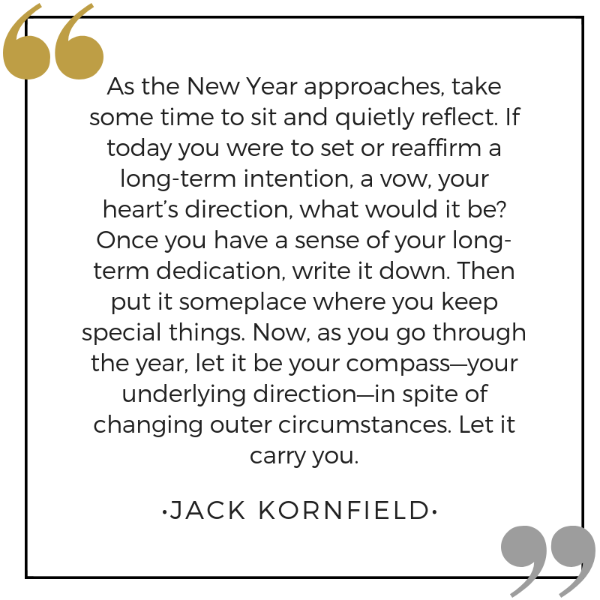
Set Your 2019 New Year Intention!
Make Room for Joy!
Sorrow prepares you for joy.
It violently sweeps everything out of your house,
so that new joy can find space to enter.
It shakes the yellow leaves from the bough of your heart,
so that fresh, green leaves can grow in their place.
It pulls up the rotten roots,
so that new roots hidden beneath have room to grow.
Whatever sorrow shakes from your heart,
far better things will take their place.
― Rumi
Ten Thousand Flowers in Spring
Ten thousand flowers in spring, the moon in autumn,
a cool breeze in summer, snow in winter.
If your mind isn’t clouded by unnecessary things,
this is the best season of your life.
― Wu-Men, The Enlightened Heart: An Anthology of Sacred Poetry
A Different Approach to Time Management
To allow oneself
to be carried away by a multitude of conflicting concerns,
to surrender to too many demands,
to commit oneself to too many projects,
to want to help everyone in everything,
is to succumb to the violence of our times.
― Thomas Merton
Clearing
Do not try to save
the whole world
or do anything grandiose.
Instead, create
a clearing
in the dense forest
of your life
and wait there
patiently,
until the song
that is your life
falls into your own cupped hands
and you recognize and greet it.
Only then will you know
how to give yourself
to this world
so worth of rescue.
― Martha Postlewaite
Top Three Attributes Microsoft CEO Looks for in a Leader
What if you are standing on a crossroad and you see a baby fall, what will you do?
Take a few minutes to read this refreshing and inspiring article by Microsoft CEO Satya Nadella Top Three Attributes Microsoft CEO Satya Nadella Looks for In a Leader where Nadella mentions the importance of:
- Creating clarity when none exists
- Creating energy and the importance of solitude
- Creating success in what is an over-constrained space
Nadella also shares that if you think about creating anything new, any new product, any new business, as a leader, the one skill that you need more than any other skill is that deep sense of empathy. Click here to read on!
Joy Leads to Better Performance!
Joy is rarer, more difficult, and more beautiful than sadness.
Once you make this all–important discovery,
you must embrace joy as a moral obligation
– Andre’ Gide, French writer
Winter is here, and for many of us, days are long, dark, and cold!, which can zap our energy, making it a little more difficult to feel upbeat and happy.
And while holiday rituals like parties, exchanging gifts, enjoying sweets, and lighting up our homes can lift our spirits, I was curious about what personal habits we could cultivate in order to feel more joyful.
What I Learned about Joy!
Not only does joy feel good on a personal level (okay, we all know that!), but it can also lead to better work environments and improved work performance! According to the WSJ’s 2018 article: The Plymouth Colony and the Business Case for Gratitude “Happy workers not only score higher for engagement, productivity, loyalty, creativity, they take fewer sick days and are more likely to help their colleagues.”
I also learned that creating happiness requires a higher order part of the brain than does negativity. In fact, negativity is the easiest and most primitive function of the brain! And while our genes and environment set the initial baseline for happiness, we can create positive habits around happiness and reverse the brain’s negativity bias!
Shawn Achor, a Harvard educated happiness researcher who works with Fortune 100 companies and author of several books including Big Potential and The Happiness Advantage, describes happiness as the joy you feel moving towards your potential and suggests the following five tips for cultivating gratitude and joy.
Five Ways to Create More Joy!
Express Gratitude – Each day find three new things you are grateful for and why. Achor calls this the the 45–second disrupter, claiming the practice has the power to transform someone from being a low level pessimist to low level optimist in just 21 days! The key is to find new things (which trains your brain to scan the environment for positive experiences) and the why (attaches positive meaning to everyday experiences that could be overlooked or taken for granted).
Journal – Each day journal about one meaningful experience by writing down three specific details about it. It’s called the doubler because the brain doubles the experience and you get to relive the experience. And according to Achor, you only need one positive memory to judge the overall day as meaningful!
15 Minutes of Cardio Exercise – Each day engage in something as simple as a brisk walk. This practice is considered a gateway drug because individuals are able see how one simple action step could improve their overall well being, which leads to and opens the door to participate in other positive happy habits. I call this the domino effect!
Meditate – Just a few minutes a day of meditation helps cultivate self compassion, decrease stress, and increase happiness. Click here to for a free mindfulness welcome packet which includes resources to help you cultivate a meditation practice.
The Two Minute Note – Each day praise, recognize or thank someone by writing them a short email note or text. Achor claims this is the most powerful of the five habits.
For more information, I highly recommend listening to The 10% Happier Podcast #156: The Science Behind Gratitude with Shawn Achor and Dan Harris.